When Physics Becomes the Monster
Hard science fiction horror does not need to abandon rigor to create fear. It often becomes more frightening because it respects constraint. A monster can be escaped, tricked, or killed. A gravitational field cannot be negotiated with. Time dilation will not change its mind.
This is why black holes are such powerful horror engines. They combine beauty, scale, silence, and inevitability. The closer a character moves toward the event horizon, the more ordinary narrative assumptions begin to fail.
The Terror of Time Dilation
Time dilation is not merely a physics concept. In fiction, it is emotional violence. It separates the traveler from home, memory, and history. A mission that lasts months for one person can erase decades elsewhere. Every message becomes a relic. Every promise is contaminated by relativity.
That distortion gives hard science fiction horror a unique psychological edge. The character may survive the immediate danger while losing the world that made survival meaningful.
The Timelike and the One-Way Mission
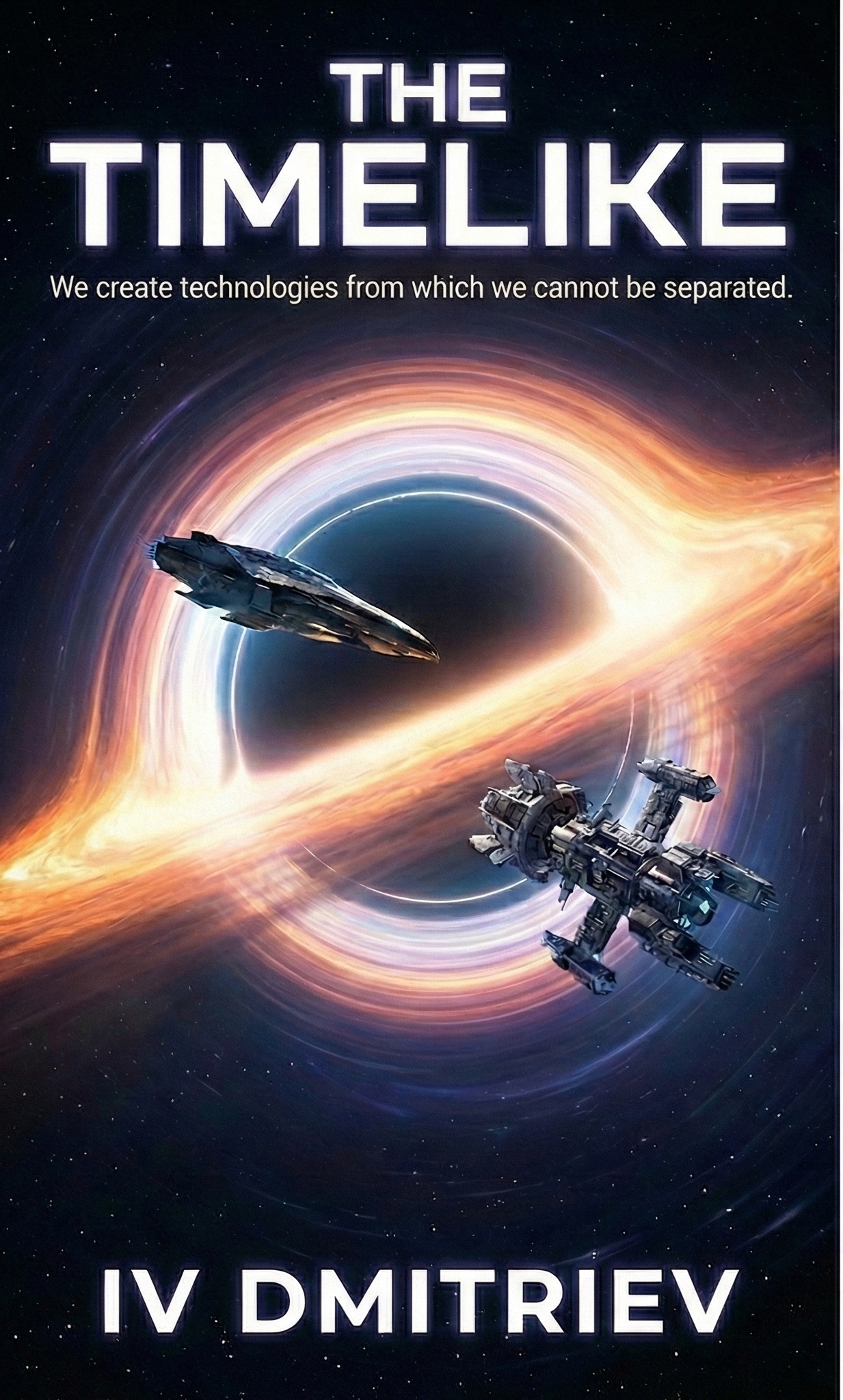
The Timelike places certified neural operator Alex aboard Theta 304, a dreadnought that is not simply piloted but embodied. His mission into the intermediate-mass black hole of Omega Centauri begins as a contract and becomes an encounter with the limits of causality, endurance, and selfhood.
The lost expedition he seeks is not just a mystery. It is a warning from a region where navigation becomes prophecy and deep-space archaeology replaces certainty. The further Alex travels, the more the story asks whether information, memory, and identity can survive in a place built to destroy sequence.
Why Claustrophobia Works in Space
Space is vast, but space horror is claustrophobic because the usable world is tiny. A capsule, a ship, a suit, a neural interface, a handful of failing protocols: these become the walls. Outside is not freedom. Outside is pressure, radiation, vacuum, distance, and silence.
Hard science fiction psychological horror is strongest when it lets readers feel both scales at once: the cosmic and the bodily. The universe is enormous. The human nervous system is fragile. Between them, story begins.
FAQ
What is hard science fiction horror?
It is horror built from scientifically grounded constraints: physics, engineering, biology, space travel, causality, or technological systems.
Why are black holes effective in fiction?
They create danger at every level: visual awe, mathematical inevitability, communication failure, time distortion, and the collapse of ordinary human scale.
Read IV Dmitriev
Explore The Seal, Where Lighthouses Are Lit, and The Timelike through the official Amazon author profile, or contact the author for rights, book clubs, publishing, interviews, and screen adaptation conversations.